Software Development
Agile Method: How It Works and Why We Chose It
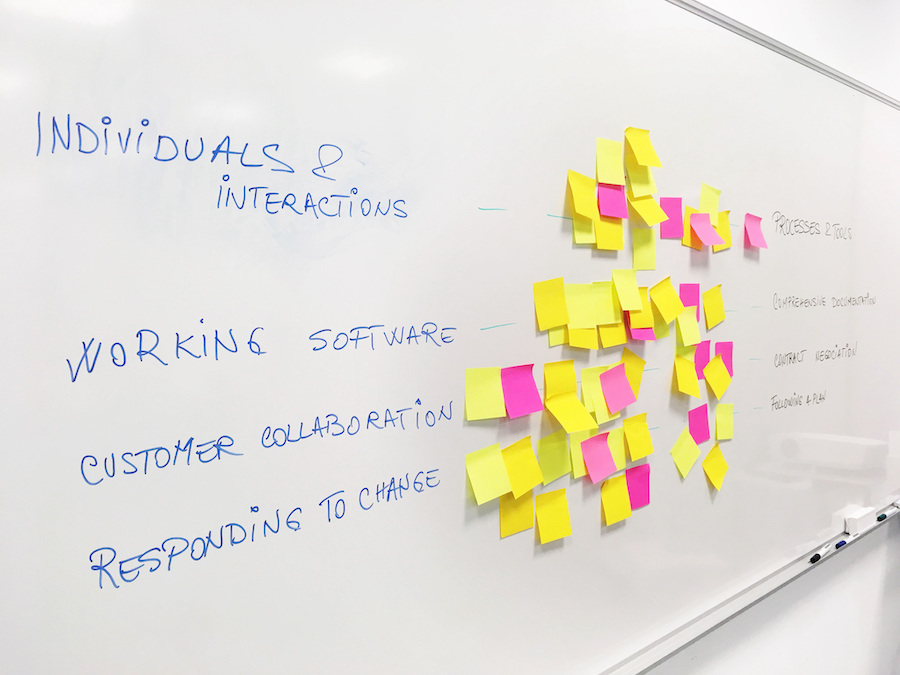
Optimizing performance, enhancing the potential of every team member, having a streamlined and fast workflow without lowering the quality of the products offered? With the Agile Methodology, it is possible. This project management approach revisits the concepts of speed and quality, two attributes traditionally seen as incompatible, making them work side by side.
Let's take a closer look at what the Agile Method is, how it can be applied, and what advantages it brings.
What Does Agile Methodology Mean?
Agile Development is an approach that, if undertaken gradually, guides and supports the team in acquiring cross-functional skills such as:
- Better time management
- More conscious use of available resources
- Optimization of the workflow
The origins of Agile date back to the early 2000s when, in response to the needs of a rapidly growing market, a group of American software developers formulated the principles of this new methodology. In the Agile Manifesto, the twelve core principles of this mindset are simply and concisely declared, aimed at improving development processes and achieving a more flexible and rapid workflow. Today, more and more companies are adopting this PM approach, which is gradually replacing traditional methodologies associated with application development centered on 'Big Design'.
How Does It Work?
Iterative product design is the fundamental premise on which this method is based. The production process is developed through so-called ‘sprints’, short iterative work sessions. During each sprint, every team member performs a series of specific tasks. At the end of each sprint, there is a results check, and any modifications to be made are established, thanks to the feedback from the final client, which will also impact the subsequent work cycle. Each sprint is aimed at refining the product in view of delivery.
The client is an integral part of the decision-making process: being constantly updated on the project, they can possibly indicate changes in priorities during the work, without slowing down development or excessively impacting the team's work. This ensures that all efforts and investments focus on what is truly a priority, and the quality/time ratio is respected.
The Advantages of the Agile Approach in Software Development
One of the objectives of the agile method is to add value to the people involved in the production process, both the final client and the development team. Indeed, this flexible methodology can satisfy the client, who obtains a final product that meets their actual needs, and the team, which sees its workflow becoming faster and more fluid. All this while fully respecting the timelines and quality of the final product.
The Advantages for the Client
Anyone working in the B2B sector knows that the priorities of a company can change rapidly to meet market demands. Those involved in software development must therefore quickly and efficiently respond to the client's needs and priorities, providing specific and tailored solutions. The agile method is ideal because it involves the client in all phases of development, considering them the major stakeholder in the production process. At the end of each sprint, the client provides feedback to the development team, highlighting any pain points and necessary corrective actions. This continuous and transparent confrontation prevents the final product from failing to reflect the client's real needs.
The Advantages for the Team
Mutual trust is a fundamental requirement for successfully implementing this methodology; in fact, one of the basic principles of Agile is not to overload individuals but to promote cooperation within the team. Implementing Agile means believing in individuals and interactions. In an agile work environment, everyone has a well-defined role in each phase of the process and collaborates with the team to achieve the final result.
Another advantage is that thanks to continuous feedback from the client, the possibility of reaching the end of a project and seeing it rejected due to misunderstandings is nullified. Transparent communication allows for greater efficiency, better results, and limited stress.
Agile and DevOps: The Winning Formula
Thanks to frequent releases, the Agile method reduces the risk of transmitting errors to a later stage of the project. Each sprint is a small project in itself and must include everything necessary to release an increment to the application's features: planning, requirements analysis, design, implementation, testing, and documentation.
DevOps is an approach to software development based on communication, collaboration, and integration between the development team and the operations team. Collaboration between Developers and Operations in all stages of product realization and release leads to improved quality, better team interaction, and faster realization times.
Is It Possible to Integrate DevOps and Agile?
The answer is yes. Both are systematic methods that outline the guiding principles for developing an effective and business-valuable application life cycle. In fact, we can almost say that they represent an improvement over each other. In summary, DevOps extends the Agile method beyond code, applying it to the entire process and including the Operations team. The union of these two approaches, both focused on flexibility, allows for accelerating the application development and release cycles, as well as ensuring their continuous and rapid evolution.
Agile PM in Astrorei
At Astrorei, we adopt the agile methodology for the development of all applications, software, web apps, mobile apps and desktop apps. We believe it is essential to adapt to the market, which requires flexibility and a predisposition to change. This allows us to establish a relationship with the client and avoid errors in the development phase that would project onto the final product. Thanks to this approach, our team is very cohesive and able to manage projects, even complex ones, without stress!

Carlo Vassallo
You might be interested in
Talk to our experts
START YOUR FREE PROJECT DESIGN
Tell us about your project, we'll give you a clear roadmap.
One of our experts will contact you within 24 hours with an initial free assessment.