Software Development
Governance and MLOps in SMEs: monitoring, security, and compliance for reliable ML models
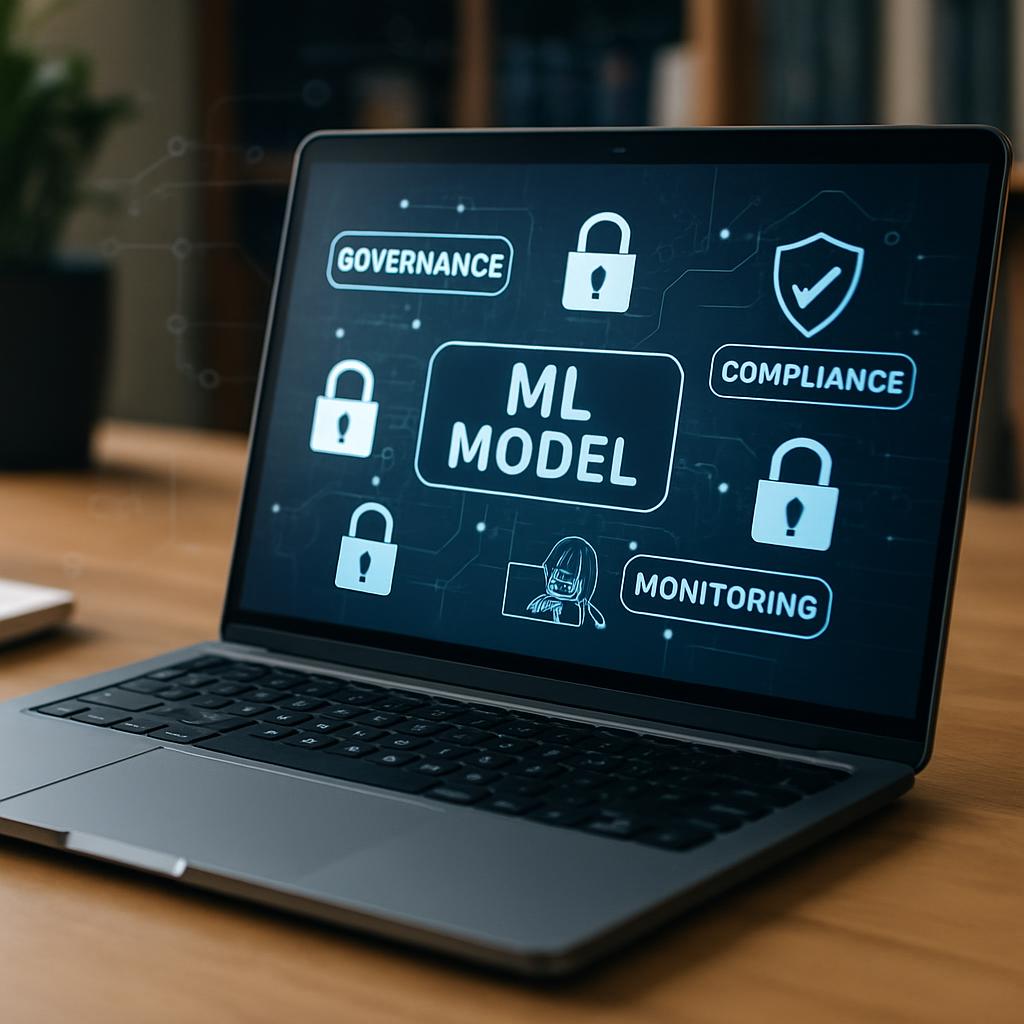
Introduction to governance and MLOps in SMEs
For small and medium-sized enterprises (SMEs) adopting machine learning solutions, securing and monitoring ML models in production is now a critical challenge. The integration of governance and MLOps not only ensures model quality, but also supports regulatory compliance and operational reliability.
MLOps governance is structured around three main areas: DataOps for data management, ModelOps for model control and validation, and RuntimeOps for production monitoring and model security. In the SME context, these practices must be rigorous yet simple to implement, effectively addressing scalability, regulatory compliance, and cost optimization requirements.
The main challenges include protection against vulnerabilities, process traceability, collaboration across multidisciplinary teams, and compliance with standards such as GDPR and ISO 27001. To address them, it is essential to adopt centralized repositories, implement secure access controls, automate testing, and ensure accurate monitoring of models in production. This allows SMEs to fully benefit from machine learning while maintaining strong security, control, and performance.
Foundations of MLOps governance for SMEs: versioning, CI/CD, and compliance
For SMEs aiming to secure ML models in production, solid MLOps governance is essential. The first step is rigorous versioning of every component: source code managed through Git, data and feature snapshots versioned with tools such as DVC or LakeFS, and models registered in centralized repositories like MLflow. This approach makes every change traceable, auditable, and reproducible, while also simplifying potential rollbacks.
CI/CD pipelines automate testing, validation, and deployment. Using tools such as GitHub Actions or Jenkins, organizations can automate data validation, code testing, and model training in a secure and repeatable way. This workflow ensures that only certified models reach production, with each step recorded in experiment tracking systems.
To ensure compliance, it is crucial to implement audit logs, role-based access control (RBAC), and precise documentation of data and model provenance. Immutable logs and Single Sign-On (SSO) provide full traceability, while granular access policies improve security and support regulatory adherence, keeping the infrastructure practical and sustainable for SMEs.
Monitoring and reliability of ML models in production
Continuous monitoring of ML models in production is essential to ensure consistent performance and reliability, especially for SMEs. An effective strategy relies on the centralized and structured collection of prediction logs and key metrics such as accuracy, loss, feature distributions, and response times. These data points should be regularly compared against predefined thresholds or historical baselines to quickly identify anomalies or drift.
Open-source tools such as Evidently AI help detect drift and significant changes automatically. Prometheus handles scalable metric collection, while Grafana provides intuitive dashboards for real-time visualization and proactive alerting. Integration with MLflow also supports experiment traceability and model lifecycle management.
Practical examples include identifying abnormal traffic spikes on e-commerce portals, monitoring error rates in predictive maintenance models, and controlling default rates in credit scoring systems. These tools and processes allow SMEs to keep models aligned with business objectives and improve the reliability of ML solutions through continuous, structured monitoring.
Operational security and compliance for MLOps pipelines in SMEs
Ensuring security and compliance in MLOps pipelines is a non-negotiable requirement for SMEs adopting machine learning. Integrating automated controls throughout the data lifecycle means encrypting information both at rest and in transit with customer-managed keys, applying access policies based on the principle of least privilege, and maintaining immutable audit logs. These measures are fundamental for complying with regulations such as GDPR and certifications such as ISO 27001.
Compliance management also includes the automatic classification of sensitive data and the anonymization or tokenization of critical fields, reducing the risk of personal data leakage. Periodic reviews, documented change-control processes, and security tests integrated into CI/CD pipelines ensure that every modification is traceable and validated before release.
A lean operational governance framework, supported by open-source tools managed with agility, enables SMEs to remain compliant and protect model integrity without compromising efficiency and agility.
Summary and benefits of an MLOps governance approach for SMEs with Astrorei
Adopting effective MLOps practices with governance is crucial for SMEs that want to secure and monitor their ML models in production. Astrorei supports this journey by providing tailored solutions that combine Agile methodologies and end-to-end CI/CD pipelines, ensuring control, transparency, and security throughout the model lifecycle.
Astrorei's solutions integrate advanced tools for data and model versioning, active drift and performance monitoring, secure deployment with granular access policies, and centralized audit logs. The Agile approach encourages frequent releases and continuous retrospectives for ongoing improvement, involving business roles such as data owners, ML engineers, and compliance officers, and promoting collaboration and knowledge sharing through dashboards and continuous documentation.
To further explore CI/CD practices in software development, we recommend our article on Continuous Integration, Continuous Deployment, and automation, which also provides useful insights for MLOps scenarios.
| Key element | How Astrorei supports SMEs |
|---|---|
| CI/CD pipelines | Automation, testing, controls, and shift-left security |
| Monitoring | Drift, performance, alerts, and shared dashboards |
| Governance | Policies, clear roles, audits, and reporting |
| Security | Dependency scanning, encryption, and RBAC |
| Agile approach | Short sprints, fast feedback, and retrospectives |
With Astrorei, SMEs can implement modern governance and MLOps practices while optimizing costs, security, and business outcomes. Relying on an experienced partner like Astrorei means turning the challenge of ML model security and monitoring into a concrete and sustainable competitive advantage.

Andrea Bellomia
You might be interested in
Talk to our experts
START YOUR FREE PROJECT DESIGN
Tell us about your project, we'll give you a clear roadmap.
One of our experts will contact you within 24 hours with an initial free assessment.