Digital Transformation
Modernizing Business Intelligence for SMEs: Data Mesh vs Data Warehouse
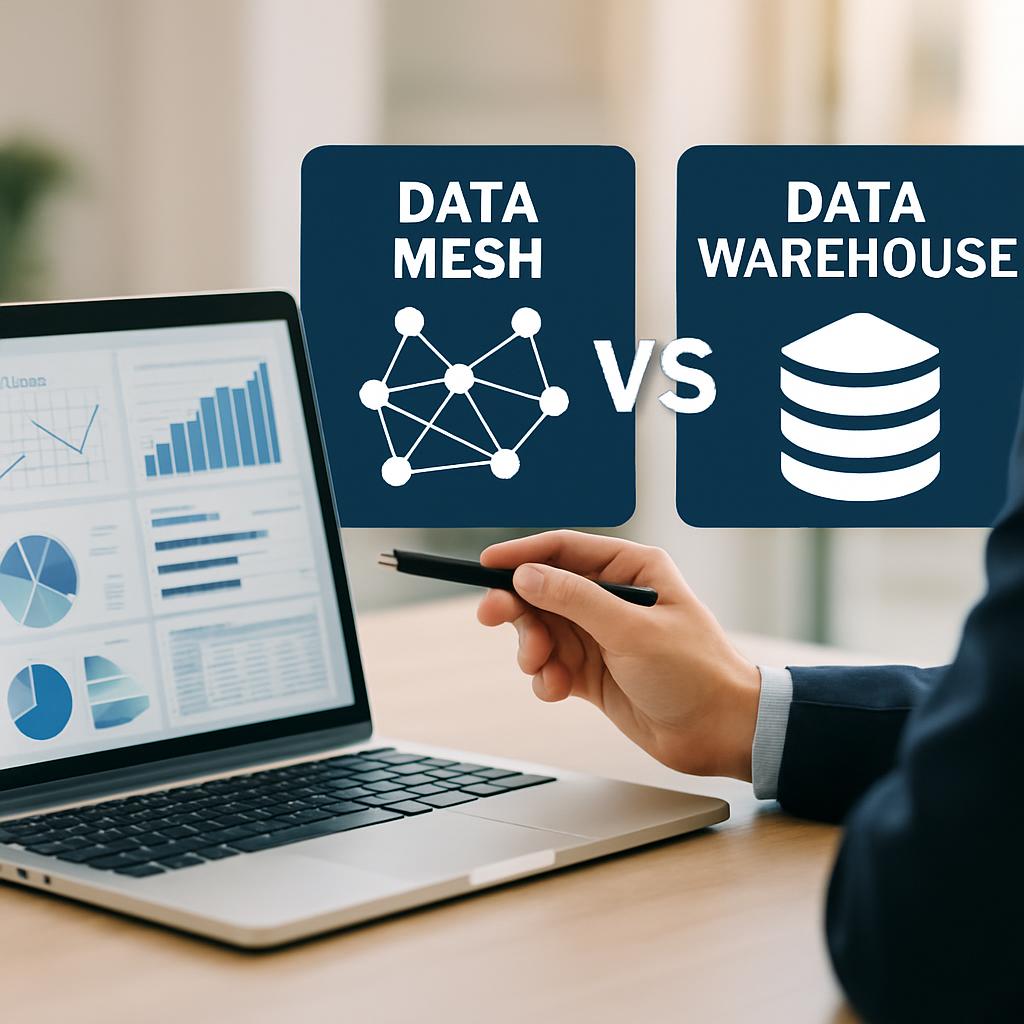
Introduction to Modernizing Business Intelligence for SMEs
Modernizing Business Intelligence (BI) is now a necessity for SMEs that want to maintain competitiveness and innovation. The quality of data and the ease of use of solutions are fundamental challenges, often underestimated by management. An effective BI transforms raw data into strategic information, essential for measuring performance, improving business positioning, and making decisions based on solid data.
Two main paradigms guide this evolution: the Data Warehouse and the Data Mesh. The Data Warehouse focuses on centralized integration of structured and historical data, facilitating governance and accurate analysis. In contrast, the Data Mesh adopts a decentralized model, promoting agility, autonomy, and collaboration among teams, particularly effective in complex and dynamic business environments.
SMEs often face challenges like integrating data from different operational areas and the limited resources dedicated to security and governance. Therefore, adopting modern, robust, and intuitive technologies is crucial to enhance BI, anticipate market trends, and maximize productivity.
Architecture and Approach: Data Warehouse vs Data Mesh
For SMEs looking to modernize their data architecture, it is essential to understand the main differences between a Data Warehouse and a Data Mesh. The Data Warehouse is structured on a centralized model: a single team collects and manages the data, creating a single source of truth and simplified governance. This is ideal for those who prioritize control, quality, and predictable costs, more suited to contexts with limited data volumes and consolidated processes.
The Data Mesh, on the other hand, proposes a decentralized architecture, where each department manages its own data flows and products independently. This approach increases agility, collaboration, and reduces IT bottlenecks, although it requires distributed technical skills and high interoperability among teams.
The most suitable choice for an SME depends on its digital maturity and the complexity of the data to be managed. The Data Warehouse offers simplicity and centralized control, while the Data Mesh promotes team autonomy and innovation. With Astrorei, an expert partner in developing custom solutions, it's possible to adopt the most suitable architecture to empower BI and optimize business processes.
Data Governance and Responsibilities in Data Mesh Models for SMEs
Data governance in a Data Mesh model represents a challenge for SMEs, which need to balance decentralization and centralized control. Best practices include adopting clear policies regarding security, quality, and data management, with particular attention to data validation, cleansing, and standardization. Periodic audits and real-time monitoring with alert systems are necessary to maintain integrity and security.
In the Data Mesh, federated governance allows domain teams to manage their data products while maintaining common standards of interoperability, security, and documentation. Key roles such as Data Owner and Data Steward are fundamental: the Data Owner defines strategic policies, while the Data Steward handles operational implementation, often covering various functions within SMEs.
Self-service tools and automated platforms are valuable for ensuring quality and access control efficiently. Supported by Astrorei, SMEs can build scalable and secure data governance, ready to support sustainable digital growth.
Advantages and Challenges of Data Mesh Compared to Data Warehouse for SMEs
Adopting the Data Mesh provides SMEs with tangible benefits in terms of scalability and agility. Decentralized management and shared responsibility among domain teams allow for quick responses to changes, direct access to data, and reduced time-to-insight. This fosters collaboration, simplifies the evolution of data platforms in complex environments, and supports diverse business needs.
However, the Data Mesh requires distributed skills and effective governance to maintain data quality and consistency, with organizational complexities that should not be underestimated. The Data Warehouse represents a consolidated solution for those seeking centralization, control, and uniformity in structured and historical data, although it requires initial investments and dedicated technical resources. Modern cloud platforms simplify Data Warehouse adoption, reducing infrastructure and maintenance costs.
For SMEs with diverse data and ambitions for rapid growth, the Data Mesh can be a forward-thinking strategy for those already advanced in data management, but it requires investments in skills and automation. In many cases, hybrid solutions that combine agility and control can represent the optimal approach.
Conclusions and Call to Action: Modernize BI with Astrorei
Here's a summary table of the differences between Data Mesh and Data Warehouse applied to BI in SMEs:
| Characteristic | Data Warehouse | Data Mesh |
|---|---|---|
| Approach | Centralized | Decentralized |
| Governance | Unified, strict | Domain-driven, federated |
| Flexibility | Limited | High |
| Scalability | Moderate | Excellent for complex organizations |
| Team Autonomy | Low | High |
| Easiness of Management | Simple for small teams | Complex, distributed management |
The choice of the most effective solution depends on the specific needs of your SME: team size, digital maturity, and data complexity. For various realities, a hybrid approach that combines control and agility represents the winning strategy.
Astrorei supports your company in every phase of digital transformation and BI process optimization. Thanks to our expertise in custom software solutions and Agile methodology, we help implement Data Mesh and Data Warehouse strategically and operationally, building custom business intelligence systems aligned with growth objectives.
Discover how to optimize your data infrastructure and increase the effectiveness of your analyses by reading our in-depth feature on Big Data and Business Intelligence.
Contact us today for personalized consulting and start modernizing your SME's BI with Astrorei, the technology partner you can rely on.

Bajram Hushi
You might be interested in
Talk to our experts
START YOUR FREE PROJECT DESIGN
Tell us about your project, we'll give you a clear roadmap.
One of our experts will contact you within 24 hours with an initial free assessment.