Software Development
Software Development: The 10 Growing Trends (Part 2)

In today's digital world, software development is the engine of innovation. From the apps we use daily to the systems managing our cities, software has become essential to modern life. But how is this sector evolving? What are the new trends shaping it? In this second part, we will explore the latest 5 emerging trends in software development that are changing the landscape and shaping the future.
1. Continuous Expansion of IoT
The Internet of Things (IoT) is not just a trend; it's a genuine revolution transforming how we live, work, and interact with the world around us. It is projected that by 2025 there will be 65 billion IoT devices, six times more than in 2018.
Examples:
- Smart Home: smart thermostats that adjust temperatures based on our habits, refrigerators that notify us when products are about to expire, lighting that adapts to our needs...
- Smart City: sensors to monitor air quality and traffic, smart streetlights that only turn on when needed, automated waste management systems...
- Industry 4.0: connected machines that communicate with each other to optimize production, robots performing complex tasks autonomously, predictive maintenance systems preventing breakdowns.
2. Progressive Web Apps (PWA): A Seamless User Experience
Smartphone users are increasingly demanding and desire an app experience that is fast, reliable, and intuitive. Progressive Web Apps (PWA) provide the perfect solution, combining standard web technology with the convenience of a native app. They are quick to load, work offline, and require no installation.
Examples:
- Twitter Lite: The PWA version of Twitter offers a user experience similar to the native app but with significantly less data usage, ideal for those with a limited internet connection.
- Starbucks PWA: Starbucks' PWA allows customers to order their favorite coffee and pay without downloading the full app, ideal for those on the go.
- Forbes PWA: The PWA version of Forbes' website provides an optimized reading experience for mobile devices, with fast loading times and smooth navigation.
3. Microservices Architecture: Agility and Scalability
Microservices architecture is a new approach to software development that breaks down applications into independent and easily manageable modules. This approach offers greater agility, scalability, and ease of maintenance.
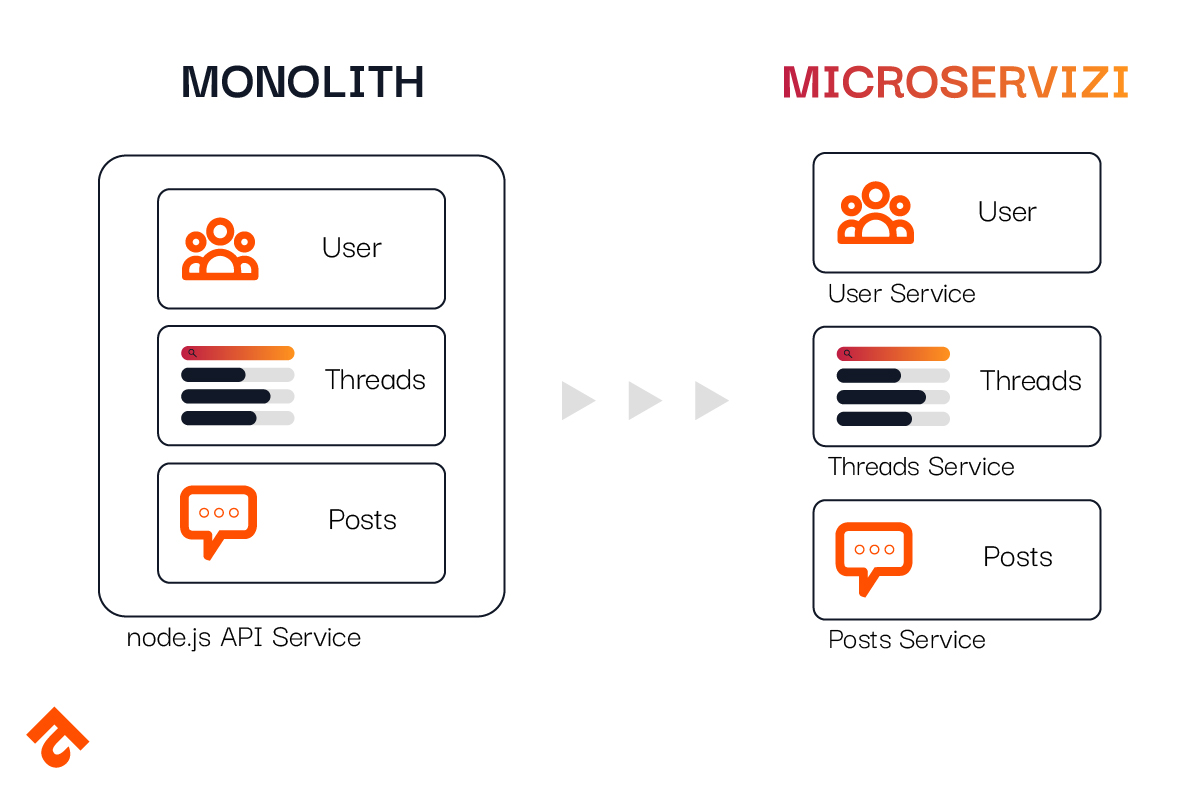
Examples:
- Netflix: Netflix's microservices architecture allows efficient and scalable management of a continuously expanding catalog of movies and TV shows with millions of users worldwide.
- Amazon: Amazon's microservices architecture is crucial for handling the enormous volume of traffic and transactions the e-commerce giant faces daily.
- Spotify: Spotify's microservices architecture provides a personalized music streaming experience to millions of users worldwide with fast response times and great stability.
4. Blockchain in Software Development: Beyond Cryptocurrencies
Blockchain, renowned for cryptocurrencies, also significantly impacts software development. Global spending on this technology is expected to grow at a CAGR of over 46% by 2024. Companies worldwide are already adopting blockchain: a Deloitte survey found that 73% of executives see it as a competitive advantage. If you're considering introducing blockchain into your company, you might be interested in this article.
Why is blockchain advantageous? Blockchain-based software systems (BOS) are incredibly secure and robust. Data is decentralized and replicated, ensuring its integrity. Public key encryption and transaction recording add an extra layer of protection. The risk of hacking or theft is minimal: users can view and record the software, but cannot modify or delete data.
A striking example: blockchain in the healthcare sector. Blockchain-based systems can connect pharmaceutical companies, hospitals, insurance companies, and other players, simplifying the recording of contractual details, transaction tracking, and payment management. Moreover, smart contracts can automate contractual terms.
dApps (decentralized applications) are another example. By leveraging blockchain, they eliminate the need for centralized intermediaries. One example is the game Axie Infinity, where users breed, trade, and battle digital creatures (Axies, NFTs). By the end of 2021, it had 8.3 million players and one million daily active users. Despite a $620 million hack in mid-2022, the game demonstrates the potential of this sector. Other blockchain games, like Game of Silks (horse racing with NFTs), are already attracting users.
5. DevSecOps: Integrated Security in Development
DevSecOps (DevOps + security) is a new method that integrates security throughout the software development lifecycle. In the past, security testing slowed down the release of new features. Today, with faster releases, traditional security can't keep up. DevSecOps solves this problem by embedding security into the development process. Programmers can fix bugs in real-time, quickly releasing secure software.
DevSecOps adoption is growing. A 2021 GitLab survey found that 70% of security professionals had already adopted this approach, up from 65% in 2020. Despite some internal concerns (45% of security teams believe developers find less than a quarter of bugs), the benefits are tangible. Companies using DevSecOps deploy code 46 times more frequently, reduce costs by 56%, and resolve security issues 144% faster.
Conclusion
The aforementioned trends represent the future of software development. Interconnection, automation, and cloud computing will continue to spread, but they also pose new challenges. As a society, are we ready to integrate so much technology into our daily lives?

Bajram Hushi
You might be interested in
Talk to our experts
START YOUR FREE PROJECT DESIGN
Tell us about your project, we'll give you a clear roadmap.
One of our experts will contact you within 24 hours with an initial free assessment.