Software Development
Software Development: 10 Growing Trends (Part 1)

The Future of Software Development: Growing Trends to Follow in 2024 and Beyond
The software landscape is continually evolving, with new technologies and methodologies emerging at a thrilling pace. For developers and companies, it's crucial to stay updated with the latest trends to remain competitive and create innovative software solutions.
In this article, we will explore the first 5 of the top 10 software development trends that are shaping the future of the industry.
1. Rapid Implementation of Artificial Intelligence (AI)
Artificial intelligence is revolutionizing almost every aspect of our lives, and software development is no exception. AI-based tools like GitHub Copilot promise to significantly boost developers' productivity. How? By automating repetitive tasks such as writing boilerplate code, fixing bugs, and suggesting alternative solutions.
A concrete example: at astrorei, we adopt GitHub Copilot as a code assistant in editor to get suggestions, code "sentence" completions, and automatic code analysis to identify potential errors or optimization areas.
In addition to GitHub Copilot, other examples of AI tools in software development include:
- AI Pair Programming: AI systems that act as "programming companions," providing real-time feedback and suggestions during code writing.
- Automatic Code Generation: Tools that can automatically generate code from verbal descriptions or UML diagrams.
- Automatic Software Testing: AI tools that can automate the software testing process, identifying bugs and vulnerabilities.
The adoption of these tools will not only increase developers' productivity but also reduce development time and costs.
2. Low-code/No-code Development
Despite the advancements of AI assistants like Copilot, creating software remains a complex process, often subject to delays and unforeseen issues. Responding to these challenges, the software development landscape has seen the emergence of a new paradigm: low-code/no-code. Low-code/no-code platforms offer intuitive interfaces that allow applications to be built through drag-and-drop and visual tools.
What are the benefits?
- Faster and Simpler Development: Software creation becomes more intuitive and immediate, speeding up the development process and reducing release times.
- Lower Costs: Development times are significantly reduced, lowering costs.
- Expanded Accessibility: Low-code/no-code opens the world of software development to a broader audience, promoting innovation and digitization even in contexts with limited IT expertise.
The numbers are clear: the popularity of low-code is on the rise. In 2022 Gartner predicted that by 2023, more than half of medium and large enterprises would adopt a low-code development platform, and evidence shows that this number is set to increase.
3. Cloud Computing: Boosting Scalability and Agility
The adoption of cloud computing is increasing as companies look for scalable and agile solutions to support their constantly evolving IT needs.
What are the advantages of cloud computing?
- Scalability: IT resources can be scaled quickly and easily to meet changing business needs.
- Agility: Companies can deploy new applications and services more rapidly and efficiently.
- Cost Reduction: Cloud computing can save companies money on infrastructure and maintenance costs.
- Accessibility: Cloud-based applications and data are accessible from anywhere and any device.
Examples of cloud computing providers:
- Amazon Web Services (AWS): The world's leading cloud service provider.
- Microsoft Azure: Microsoft's cloud platform.
- Google Cloud Platform (GCP): Google's cloud platform.
Cloud computing is transforming how companies develop and distribute software. Companies adopting the cloud can benefit from increased scalability, agility, and cost reductions.
4. Cybersecurity: Defending Against Rising Threats
Cybersecurity has never been more crucial. With the exponential increase in cyberattacks, especially ransomware, companies must be prepared to defend their data and assets.
The statistics are alarming.
- Ransomware attacks are rising: from 304.64 million in 2020 to 493.33 million in 2022, a 61% increase.
- Ransom payments are on the rise: the average payment increased from $233,000 in November 2020, with a 31% increase in the fourth quarter of the same year.
- Attack tactics are evolving: double extortion, where data is stolen and then threatened with publication if a second ransom is not paid, is increasing.
- The consequences are devastating: attacks on government entities, hospitals, and energy companies have had a significant impact.
How to defend?
- Security Automation: Implementing automated solutions can save companies up to $3.58 million in the event of a data breach.
- Cyber Insurance: Cyber insurance is becoming increasingly important, with a 135% increase in Google searches over the past 10 years. However, with the rising costs of attacks, insurance coverage may no longer be sufficient in the future.
5. Rust: The Rising Programming Language
Rust is gaining popularity among developers due to its numerous advantages.
- Memory Safety: Rust eliminates the risk of memory-related bugs, one of the main causes of software vulnerabilities.
- Speed and Performance: Rust offers excellent performance, comparable to C and C++.
- Reliability: Its ownership system ensures robust and reliable code.
It's no surprise that Rust has been the "most loved" programming language for the past four years according to Stack Overflow.
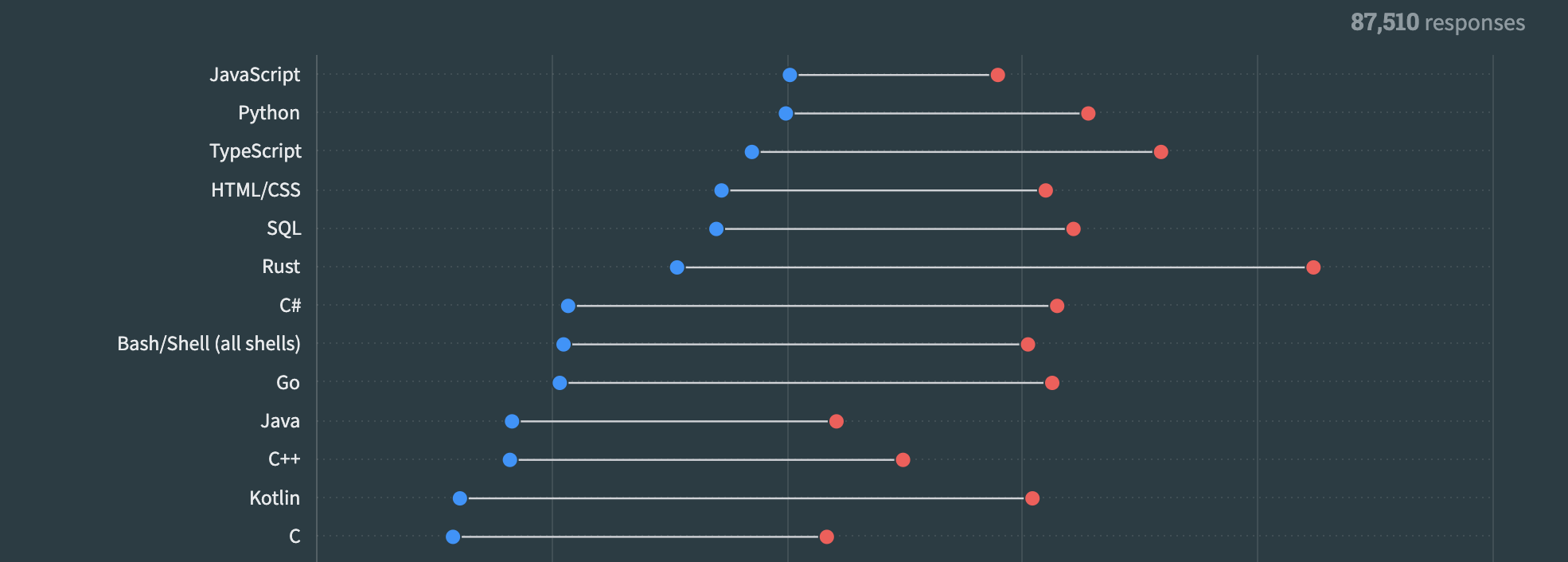 According to Stack Overflow, Rust is by far the most loved programming language by developers.
Major companies like Facebook, Dropbox, and Amazon use Rust in production, and the Rust Foundation, established in 2021, is actively investing in the development of the language.
To connect to the previous point, hackers are also starting to exploit Rust's potential, creating malware like RustyBuer.
Stay tuned to discover the next software trends that will revolutionize how we develop and use technology!

Bajram Hushi
You might be interested in
Talk to our experts
START YOUR FREE PROJECT DESIGN
Tell us about your project, we'll give you a clear roadmap.
One of our experts will contact you within 24 hours with an initial free assessment.