Software Development
Agentic AI: Strategic Guide to Digital Transformation in 2025
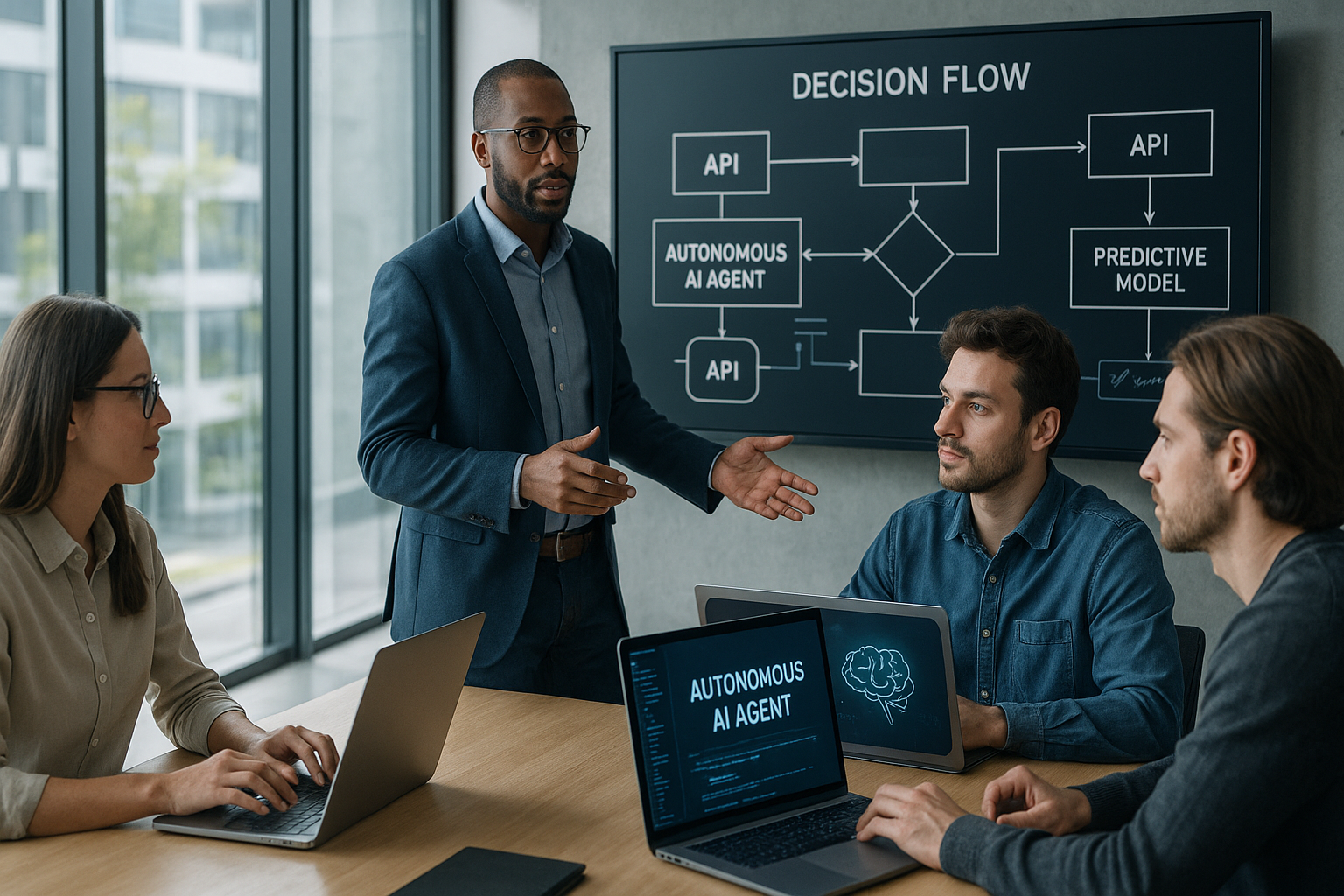
What is Agentic AI and Why It Revolutionizes Companies in 2025
In 2025, Agentic AI represents a new frontier for digital companies seeking autonomous workflows and intelligent business automation. These are intelligent systems capable of operating autonomously, making data-driven decisions and planning actions to achieve business goals without requiring constant supervision.
This evolution of artificial intelligence transcends the limits of classic automation, allowing complex business processes to be managed flexibly and adaptively. Agent systems use advanced architectures that combine machine learning, natural language processing, and intelligent automation to create a true digital workforce.
The adoption of these technologies is transforming digitization in every business area, from Finance to Marketing, from Supply Chain to Customer Service. Thanks to continuous learning and integration with advanced language models and APIs, companies can optimize operational flows, reduce repetitive tasks, and gain strategic insights quickly.
For companies like Astrorei, innovation means offering custom solutions that can leverage autonomous agents within tailor-made processes. Agent systems thus become a concrete lever for improving efficiency, competitiveness, and operational agility, helping CEOs, CTOs, and innovation leaders seize new opportunities in the digital age.
Agentic AI vs Traditional Automation: Key Differences for Companies in 2025
Unlike traditional artificial intelligence, which requires constant human input and supervision, agent systems are designed for autonomous decision-making. Their distinctive capabilities include:
- Advanced contextual reasoning: analyzing and interpreting complex data in real-time using cognitive processing and advanced analytics.
- Intelligent adaptive planning: modifying strategy and action in response to environmental changes through adaptive learning algorithms.
- Persistent evolutionary memory: learning from experience and retaining operational knowledge for continuous improvement.
- Direct action capability: interacting with systems, APIs, tools, and end-users through intelligent process automation.
These agents are based on advanced architectures that combine large language models (LLM), multi-step planning components, and interfaces for external tools. An example is the "Agentic Mesh" architecture, enabling collaboration among multiple specialized agents through multi-agent systems.
Distinctive Features and Capabilities: How Enterprise AI Automation Works
Agent systems stand out for their decision-making autonomy and continuous learning, elements that go beyond mere traditional automation. Thanks to deep neural networks and advanced language models, these intelligent agents can independently plan, reason, and make complex decisions.
In digital companies, agent technologies find applications in contexts such as:
- autonomous trading and algorithmic decisions;
- advanced customer service via intelligent chatbots;
- healthcare scheduling and patient management;
- automated credit scoring and risk assessment;
- supply chain optimization and demand forecasting.
Systems like Salesforce's Agentforce demonstrate how an "agent layer" can act as a digital workforce, operating 24/7 and enhancing business operational efficiency.
Continuous learning capability allows agents to acquire new skills by assimilating data and experience, continuously improving their decisions. At Astrorei, we believe that integrating these systems represents a strategic lever for innovation-oriented companies, especially in highly complex and fast-paced decision-making environments.
Concrete Use Cases and ROI Metrics: Agentic AI for CEOs and CTOs 2025
Enterprise AI use cases are multiplying across all sectors. Here are some examples from concrete digital transformation experiences.
- Banking and Fintech: up to 50% acceleration in reconciliation processes and fraud detection (source: McKinsey).
- Digital Healthcare: +25% efficiency in patient management thanks to agents capable of interpreting medical records and planning appointments.
- Retail and Smart Logistics: predictive analytics, real-time inventory management, supply chain intelligence.
- Customer Experience: it is expected that by 2029, 80% of common requests will be resolved autonomously by AI agents (source: Gartner).
KPI and Measured Business Impact Metrics
- 34.2% reduction in task completion times
- +13.6% efficiency in resource use
- +45% productivity in tech teams
- ROI >3.6x within the first year of adoption
- 40% business process optimization
Strategic Impact for CEOs, CTOs, and Innovation Leaders: AI Strategy 2025
Agentic AI marks a turning point for business decision-makers, offering tangible benefits such as increased operational efficiency through the automation of entire business workflows, not just individual tasks. This reduces operational costs and accelerates time-to-market, thanks to autonomous and adaptive decisions based on real-time data.
Enterprise scalability is another strength: Agentic AI allows implementing solutions that integrate deeply with enterprise systems, transforming small pilot projects into large-scale strategic initiatives.
Benefits for C-level executives:
- Strategic automation of core processes.
- Competitive advantage through AI-driven innovation.
- 24/7 scalable digital workforce.
- Automated data-driven decision making.
Astrorei supports CEOs, CTOs, and innovation leaders on this path, offering tailored AI solutions, strategic consulting, team integration, and custom digital product development. Thanks to an Agile approach and the team’s cross-functional experience, Astrorei helps companies build lasting competitive advantages.
Practical Implementation: Roadmap to Enable Agentic Transformation
For effective adoption of enterprise AI, it's crucial to follow a structured path:
- Strategic AI Discovery: analysis of high-potential intelligent automation workflows and identification of business bottlenecks.
- Pilot Development & MVP: creation of functional prototypes and measurement of business impact.
- Enterprise Scaling & Integration: progressive integration with legacy systems and business processes.
- AI Governance & Optimization: definition of AI policies, auditability, and continuous monitoring.
Astrorei supports this process by providing:
- design of custom agent architectures.
- Custom software development and API integration.
- Dedicated teams for development, governance, and compliance.
- IoT solutions, 3D and data analytics integrated into intelligent ecosystems.
Risk Management and AI Safety: Mitigation Strategies
The growing autonomy of AI agents, however, also introduces new technological risks such as memory poisoning, error propagation across interconnected systems, and deviation from original goals.
To mitigate them, it is essential to implement responsible AI frameworks with adversarial testing, continuous monitoring, external audits, and decision transparency.
Conclusion: Why Choose Astrorei for Your AI Strategy
Astrorei is the ideal partner for companies looking to integrate Agentic AI with a strategic and personalized approach. Thanks to our expertise in custom solutions, Agile methods, and ability to operate on advanced technologies (React, Node.js, Angular, Flutter, IoT, VR/AR), we support our clients in every phase of AI adoption.
We work side by side with CEOs, CTOs, and innovation leaders to:
- Enhance decision-making flows with autonomous AI systems.
- Integrate specialized teams flexibly and scalable.
- Ensure scalability, security, and regulatory compliance.
- Accelerate digital transformation through AI-driven innovation.
The evolution towards autonomous business models is not a fleeting trend but a structural change. Investing now in Agentic AI means positioning competitively for the future of enterprise automation.
Find out how we can support your company's digital transformation: contact us.
FAQ: Frequently Asked Questions about Agentic AI for Companies
What is Agentic AI and how does it differ from traditional AI?
Agentic AI is an advanced form of artificial intelligence that can operate autonomously, making decisions and taking actions without constant human supervision. Unlike traditional AI which requires specific inputs, AI agents can plan, reason, and adapt to new situations using advanced machine learning and cognitive computing.
What are the most common use cases in 2025?
Major use cases include: autonomous trading, customer service automation, supply chain optimization, healthcare management, banking fraud detection, and industrial predictive maintenance. Companies are implementing these systems to achieve operational efficiency and competitive advantage.
What risks does Agentic AI entail and how to avoid them?
Primary risks include memory poisoning, cascading hallucinations, and intent breaking. To mitigate them, it is essential to implement robust AI governance, continuous monitoring, adversarial testing, and Responsible AI frameworks with independent external audits.
What is the expected ROI from the implementation of Agentic AI?
Companies report an average ROI >3.6x within the first year, with 34.2% reduction in task completion times and +45% productivity in tech teams. The business impact varies based on the sector and complexity of the implementation.
How to choose the right partner to implement Agentic AI?
It is crucial to choose a partner with proven experience in AI development, enterprise integration, and custom solutions. The ideal partner should offer strategic consulting, agile development, dedicated teams, and full support from the pilot phase to enterprise scaling.

Kristian Notari
You might be interested in
Talk to our experts
START YOUR FREE PROJECT DESIGN
Tell us about your project, we'll give you a clear roadmap.
One of our experts will contact you within 24 hours with an initial free assessment.