Software Development
Backend, Frontend, and Full Stack Developers: The Differences

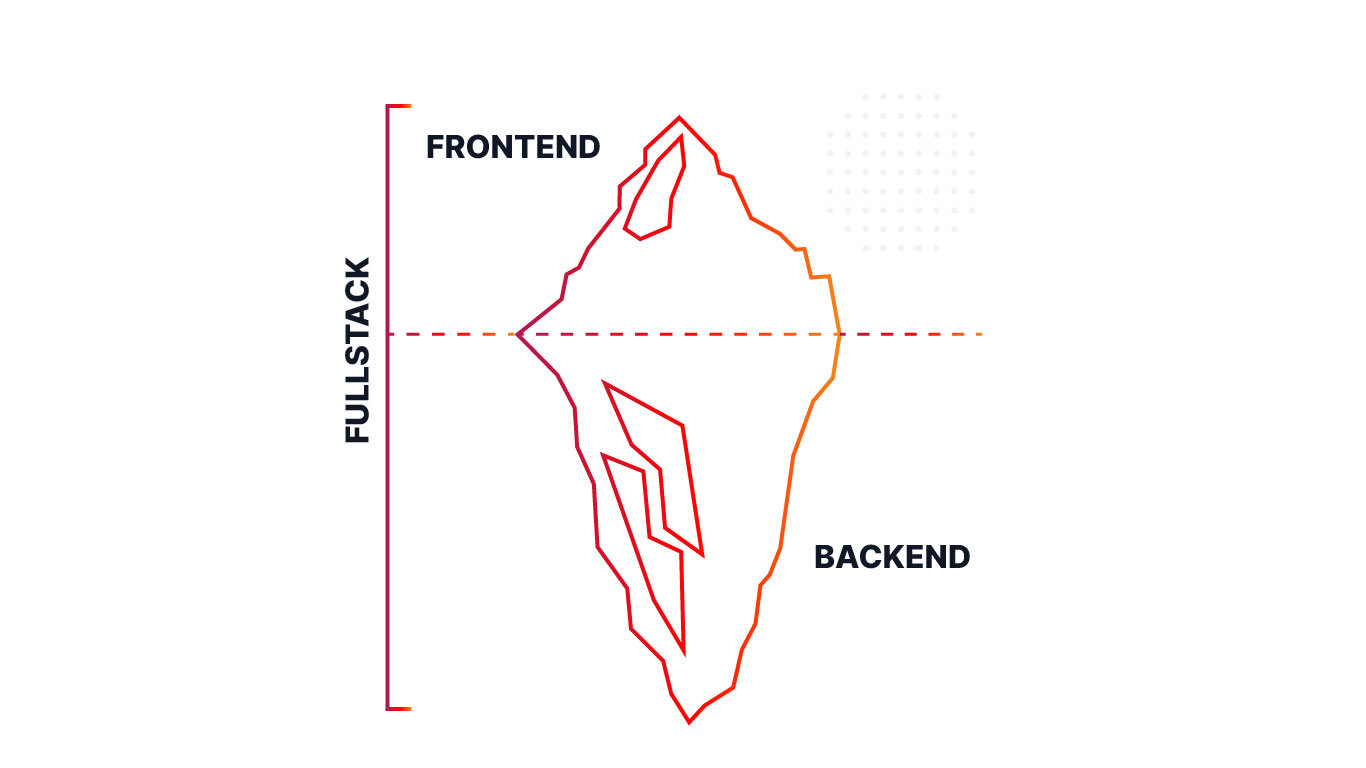
To understand the difference between the backend and frontend, we can compare a website or any digital product to an iceberg. There is a visible part to the user (the tip of the iceberg), which they can interact with, and a hidden, deep part that supports the functioning of the entire system. The visible part of the site or app is the front end, while the invisible part is the back end. The full stack developer, however, is versatile across the iceberg and can handle both the visible and non-visible parts thanks to their knowledge.
If you need to develop software, an app, or a website, you're probably wondering which type of developer you should look for. This short guide will clarify these development types, what are the differences and fields of application of backend and frontend, what programming languages and frameworks are most used, and what it means to be a full stack programmer.
Backend Developer: What They Do
The backend developer deals with everything the end user does not see (and should not see!). They work behind the scenes of the project, without dealing with the interface. The languages used are defined as server-side and are used to create logical structures that, utilizing databases, will manage data of all types. The backend part is essential for studying user behavior when using the front end, for acquiring commands, and formulating appropriate responses that provide the user with the required data. In summary, the backend developer creates the calculations and logic that support the frontend and offer a dynamic experience to the user. Some of the most used frameworks are: Django (which uses the Python language and is currently used for Instagram's backend), Spring Boot (which uses Java), and Node.JS (based on Javascript).
The deeper part handles data storage. All processed content must be stored in a safe and well-organized area, namely the database. Specific languages like SQL, Structured Query Language, are used to access, update, and reorganize the database data. The most used databases at the moment are MySQL, PostgreSQL, and MongoDB.
Frontend Developer: The Client Side
The frontend developer handles everything the user sees and interacts with using a site, an app, or software. This part is also referred to as Client-side as it focuses on the interactive user-side experience. The main elements that guarantee the user a pleasant, aesthetic, and interactive visual experience that a frontend developer takes care of are:
- Texts
- Colors
- Fonts
- Images
- Buttons
- Links
- Menus
- Input fields
- Brief animations
Front-end Technologies and Languages
We can classify the technologies used into two large macro groups.
Content and Visual
"Surface" technologies (the tip of the iceberg) deal with the visual and aesthetic rendering of the site. The most used languages are HTML (HyperText Markup Language) and CSS (Cascading Style Sheets). They are used to choose which elements to include on a page and the position and style these elements should have. Often in frontend development, frameworks and libraries are used that provide ready-to-use HTML and CSS utilities and elements to simplify and speed up developers' workflow. Among the most used are Tailwind Ui, Antdesign, and MUI.
Interaction
This second category includes all technologies that make page elements interact and cooperate. In this case, the most used language is definitely Javascript, which allows us to see notifications, add comments or likes, complete forms, and much more. The most used Javascript frameworks are React (which we talk about more in this article), Angular, and Vue, and they are optimized for creating Single Page Applications. Web applications built on a single page that react to every user action, changing appearance and content dynamically, without the need to load new pages.
Full-stack Developer: Who They Are and What They Do
Full Stack Programmers are familiar with all the parts of development we have mentioned so far. Even though no developer can be a specialist in all technologies, as there are many, a full-stack developer knows in detail how these communicate and interact with each other, which is why they are usually a key element within development teams.
They must possess transversal skills that enable them to carry out various activities, such as:
- Implement the design of a web page;
- Format static and dynamic web graphic elements;
- Analyze and resolve potential code issues (test & debug);
- Optimize server and code speed, stability, and scalability;
- Create and integrate APIs;
- Create and implement data storage solutions.
The list of skills for a Full Stack Developer is therefore really wide but can be summarized in 7 fundamental elements: knowledge of servers, network, and hosting; data modeling, Business Logic; API layer / Action layer / MVC, UI (User Interface), and UX (User Experience). Finally, it is very important for this role to refine their ability to understand the needs of the client and the end user.
Now that we have seen the main differences and the specific tasks of these three roles, it becomes clear that none is better than the others. All are indispensable in a specialized development team to create efficient and high-quality solutions. The Astrorei team is composed of backend, frontend, and full stack professionals capable of supporting any kind of project, even the most complex ones.

Carlo Vassallo
You might be interested in
Talk to our experts
START YOUR FREE PROJECT DESIGN
Tell us about your project, we'll give you a clear roadmap.
One of our experts will contact you within 24 hours with an initial free assessment.