Software Development
Metaverse: What It Represents for Developers
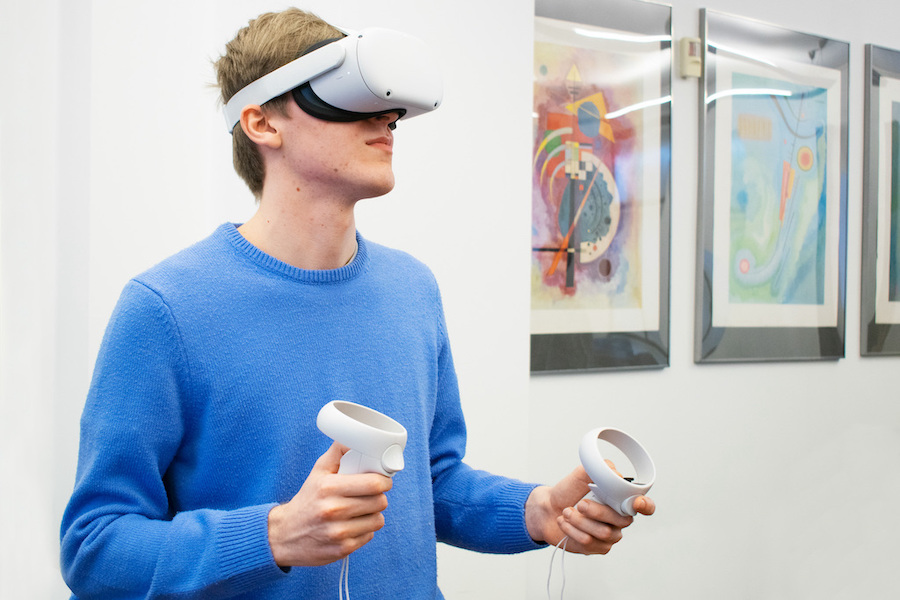
The word metaverse originates from the Greek meta meaning beyond and verse, as an abbreviation of Universe. In other words, we can define the metaverse as something that surpasses, transcends the real universe. The term was coined in 1992 by Neal Stephenson in Snow Crash. In his cyberpunk science fiction book, he describes the metaverse as a virtual reality shared via the internet, where one is represented three-dimensionally through their avatar. But why is everyone talking about it?
Even though we might define 2022 as the "Year of the Metaverse," due to its significant media coverage, such technologies have existed for several years. Just think of the numerous multiplayer video games or even Second Life, where users, through their avatars, could interact with other users. The fundamental difference between these worlds and the metaverse lies in the connection and interconnection between various realities: in the metaverse, it will indeed be possible to make many different realities interact, even those built with different technologies, while the aforementioned examples of the metaverse were isolated realities.
The business opportunities and the cutting-edge nature of this technology have made it one of the most discussed topics in recent months, especially since Facebook announced its intention to focus on the metaverse for the future of its platform. A true internet revolution, thanks to which it will be possible to integrate augmented and virtual reality applications and objects to enable the integration of humans themselves, through avatars, within it. But it's not just Meta moving in this direction; many other companies are investing in the Metaverse, creating a new market and new opportunities for the development world.
Opportunities for Developers
From a technical perspective, we can define it as a series of virtual "worlds," centered on creating interactions and social connections. Perhaps in the near future, many of the services accessed via the internet will be replaced by services only reachable in the metaverse. Today, we use Web 2.0 technology, where smartphones, laptops, smartwatches, and all the devices we use daily have become interactive and have far broader capabilities than just basic devices. By connecting to each other, they allow us to perform numerous actions, monitor our data, and share them across multiple devices. With Web 3.0, which will be the foundation of the metaverse, devices will also combine AR and VR elements to allow users to interact better with the internet. For this reason, it is a perspective that could radically change the programming and development landscape in the coming years.
What technical skills will be necessary to become a Metaverse Developer?
- Programming: The required programming languages will be the most widely used today, such as JavaScript, Swift, Kotlin, and certainly C/C++.
- Software Development: Given the vastness of the metaverse, it will be essential to know how to create and develop different types of apps: games, web development, and mobile app development. Due to its distribution across types of devices, developers should be capable of developing apps for every platform.
- XR Technologies: The metaverse will be closely linked to augmented, virtual, and mixed reality. The encapsulation of all these technologies has been defined as XR or extended reality. The ability to program and develop technologies for XR will thus be a considerable advantage for developers.
- SDKs: These are kits for developing apps and software for the metaverse that include the architecture of the existing metaverse development. Among the most popular are Babylon.js, Wikitude, Vuforia, and others. Knowledge of these XR SDKs is thus of fundamental importance.
- 3D Development: Being composed of many 3D objects, avatars, and structures, having the ability to design and develop in 3D will be one of the most appreciated skills.
Development of VR/AR/3D Apps for the Metaverse
As we have just seen, augmented reality, virtual reality, and 3D will be essential for the metaverse. At Astrorei, we like to stay prepared for new developments: we have tested ourselves in developing Applications and Software for virtual reality, augmented reality, and 3D. Recently, numerous platforms for the development of Augmented Reality apps have emerged, and while Unity dominated the AR sector in the past, since 2017, many other platforms have been added, such as Apple ARKit, Google ARCore, Snapchat Lens Studio, Facebook AR Studio, and Amazon Sumerian.
At Astrorei, we create reliable and fully custom VR/AR and 3D applications, focused on the specificities and objectives of a particular business. We believe that to create something of value, the best way is to combine the technological aspect with human strengths. This is precisely why we believe VR and AR technologies are a significant innovation. Perhaps the development of these apps will profoundly change training and skill development, interaction between people, and purchasing habits. For this reason, we invite all companies to consider adopting as soon as possible what the digital revolution we are experiencing has to offer.

Kristian Notari
You might be interested in
Talk to our experts
START YOUR FREE PROJECT DESIGN
Tell us about your project, we'll give you a clear roadmap.
One of our experts will contact you within 24 hours with an initial free assessment.